
The automotive industry is undergoing a profound transformation driven by digital innovation, changing consumer expectations, sustainability initiatives, and advancements in artificial intelligence. What was once a purely mechanical industry is now deeply integrated with software and data intelligence. From software‑defined vehicles to advanced AI‑powered safety systems, 2026 marks a pivotal year for automotive technology trends that are shaping how vehicles are designed, manufactured, driven, and experienced.
This blog explores the most impactful trends influencing the automotive landscape today and into the near future. These trends aren’t just buzzwords — they represent real shifts in how cars are built, how they perform, and what drivers expect from their vehicles.
1. The Rise of Software‑Defined Vehicles (SDVs)
One of the most transformative automotive technology trends is the emergence of software‑defined vehicles (SDVs). In an SDV, much of what used to be controlled by hardware is now managed by software. This means vehicles can be updated remotely via over‑the‑air (OTA) updates, much like a smartphone, introducing new features, fixing bugs, and improving performance after the vehicle has already been sold.
SDVs change the competitive landscape in the automotive industry. Automakers no longer compete purely on horsepower and body design; instead, they compete on software capabilities, user experience, and continual feature upgrades. The shift toward SDVs also helps brands stay relevant longer as software can be iterated independently of the physical hardware.
Because software now defines the vehicle’s intelligence, this trend stretches across infotainment, climate control, driver‑assist interfaces, and even propulsion management. Google’s expansion of Android Automotive OS is a real example of this shift — the platform is growing from basic infotainment to managing non‑safety systems like lighting, climate control, and digital keys.
2. Artificial Intelligence as the Core of Automotive Innovation
Artificial intelligence (AI) has become central to automotive innovation across the product lifecycle — from design and manufacturing to end‑user experience. Companies like General Motors are embedding AI deep into vehicle design workflows with tools that convert sketches into 360‑degree visualizations and test aerodynamics digitally, dramatically reducing development timelines.
AI enhances numerous vehicle functions:
- Advanced Driver Assistance Systems (ADAS) — AI powers smart lane keeping, adaptive cruise control, collision detection, and predictive braking.
- Driver Monitoring — Cameras and algorithms monitor fatigue and distraction, alerting drivers before risk escalates.
- Voice Recognition — Natural language capabilities turn cars into conversational assistants, expanding beyond simple command systems to intuitive co‑pilots.
At vehicle manufacturing facilities, AI is used to reduce inspection errors and improve quality by predicting potential defects before they occur. Instead of spotting flaws after the fact, systems now correlate real‑time data from sensors with production conditions to prevent quality issues.
This trend also extends to industrial AI, where generative AI and machine learning help diagnose machine failures quickly on the factory floor, speeding up maintenance and reducing downtime.
3. Connectivity and Vehicle Intelligence
Today’s vehicles are far more connected than ever. Vehicle‑to‑everything (V2X) communication — where vehicles communicate with other cars, infrastructure, and even pedestrians — is becoming an essential part of automotive technology. This connectivity supports real‑time traffic insights, predictive maintenance, and safety alerts, improving overall mobility experiences.
Connectivity also powers cloud‑based services, remote diagnostics, and enhanced customer experiences. Through cellular networks, Wi‑Fi, and even edge computing, vehicles can process data locally for instantaneous decision‑making while still leveraging cloud systems for broader learning and analytics.
This digital connectivity is especially vital for autonomous driving systems, which depend on rapid, accurate real‑time data to make safe navigation decisions. As connectivity continues to improve, so too does the capability for higher levels of autonomy.
4. Autonomy: Moving Toward Self‑Driving Capabilities
Autonomous driving continues to evolve as a defining automotive technology trend. Fully self‑driving vehicles (Level 4 and 5 autonomy) are still being refined, but Level 2 and Level 3 systems are already mainstream — handling tasks like highway driving and traffic jams with minimal driver input.
Advances in sensors, including cameras, radar, and lidar, provide a robust sensing suite that enables vehicles to interpret their surroundings with higher accuracy. AI interprets this sensor data in real time, enabling vehicles to respond effectively to their environment.
This shift toward autonomy is not just about convenience — it’s also a safety imperative. Improved autonomy reduces human error, which is one of the leading causes of collisions. Automakers and technology companies continue to test and refine autonomous systems, with fleets of robotaxis and test vehicles pushing the industry forward.
5. Electric and Alternative Powertrain Trends
While electrification has been a major focus over the last decade, 2026 marks a phase where electric vehicle (EV) trends become more integrated with other technologies. High‑voltage architectures, such as 800‑volt charging systems, reduce charging times and improve energy efficiency.
Solid‑state batteries, which offer higher energy density, faster charging speeds, and enhanced safety compared to traditional lithium‑ion batteries, are poised for potential mass adoption in the near future. These advancements will improve driving range while addressing common EV drawbacks such as long charge times.
While EV adoption remains high, hybrid vehicles are also evolving, delivering better electric‑only range and combining the best aspects of combustion and electric powertrains.
6. Interior Transformation: Digital and Augmented Experiences
The modern vehicle interior is far more than seats and dials. Panoramic digital displays, integrated AR‑augmented navigation, and fully customizable driver environments are becoming standard in premium vehicles. These interfaces not only provide entertainment but also enhance safety and information delivery.
In‑car AI assistants listen to natural language and act as co‑pilots, managing climate, navigation, and even predictive alerts. These intelligent systems can anticipate driver preferences, provide personalized settings, and optimize comfort and safety.
Augmented reality (AR) heads‑up displays project navigation and hazard alerts directly into the driver’s line of sight, reducing distraction and improving situational awareness.
7. Advanced Safety Systems Beyond Traditional Braking
Safety remains a core driver of automotive technology trends. Beyond airbags and seatbelts, modern vehicles are equipped with predictive systems that anticipate potential risks and intervene accordingly. These include:
- Automated emergency braking
- Intelligent speed assist
- Driver monitoring systems
- Enhanced pedestrian detection algorithms
These advanced systems use sensor fusion (combining radar, lidar, and cameras) and AI interpretation to make decisions within fractions of a second to prevent accidents or minimize their impact.
8. Manufacturing Innovation and Digital Transformation
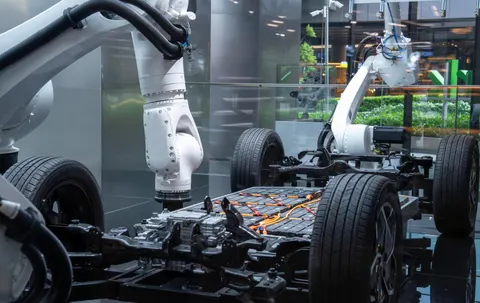
Technology is reshaping automotive manufacturing just as profoundly as driving technology. Data‑driven systems, AI‑powered maintenance tools, and private 5G networks provide reliable factory connectivity and real‑time analytics that increase efficiency and decrease downtime.
Factories are deploying robotics, digital twins (virtual replicas of production systems), and advanced simulation tools that speed product development and improve assembly accuracy.
These manufacturing innovations are critical as the industry transitions to software‑centric vehicles with complex architectures.
9. Sustainability and Eco‑Focused Engineering
Sustainability has become a cornerstone of automotive innovation. Automakers are adopting lightweight materials, recycled content, and eco‑friendly manufacturing processes to meet stricter emissions standards and consumer expectations. This includes bio‑based plastics, plant‑derived interiors, and circular design principles that reduce waste and environmental impact.
Conclusion: The Automotive Industry in Transition
The automotive world in 2026 is being reshaped by software, AI, connectivity, and electrification. Cars are no longer just mechanical machines; they are intelligent mobility platforms powered by software and data. This transformation brings exciting opportunities — safer roads, more efficient vehicles, better driving experiences, and new business models built around continual digital upgrades and services.
For automotive industry professionals, staying ahead of these trends means embracing technology, fostering innovation, and rethinking traditional approaches to design, manufacturing, and customer engagement.